Bridget Regan
One-on-one coaching has a structural problem that no amount of hustle fixes: there's a hard ceiling on how many people you can serve. Every coach who builds real traction hits it. And the traditional ways of breaking through — group programs, pre-recorded courses, membership communities — solve the time problem by sacrificing the thing that made the business work in the first place. The personal connection.
A new category of AI is changing that math. AI Twins — digital replicas trained on a specific person's voice, knowledge, and methodology — are letting coaches scale their one-on-one presence without diluting it. This isn't about replacing human coaching. It's about extending it to the hundreds or thousands of people who want access to your thinking but can't get on your calendar.
The Ceiling Every Coach Hits
You have 24 hours in a day. If you're booked at 20 clients, you're either turning people away, raising your rates until only a handful can afford you, or grinding toward burnout trying to squeeze in one more session. Most coaches hit this wall within a year or two of building real momentum.
The instinct is to systematize. Build a course → Launch a group program → Create a membership site. And those work, to a point. Revenue goes up. But something else happens too: the experience changes. Your clients didn't sign up for a curriculum or a Zoom room with 50 other people. They signed up for you. Your thinking, your frameworks, the way you respond to their specific situation in real time. That's the part that supposedly can't scale.
The coaching industry has accepted this trade-off as inevitable. You can be personal, or you can scale. Pick one.
That's no longer true.
What an AI Twin Actually Does for a Coaching Business
An AI Twin is a digital version of a specific person, trained on their actual content, from podcasts and videos to course materials, coaching frameworks and written work, that holds real 1:1 conversations with their audience. Not scripted FAQ responses or decision-tree flows, but real, dynamic, contextual conversations that draw on the creator's methodology and adapt to each individual user.
The best AI Twins support real-time voice conversations using cloned voice technology. Your Twin doesn't just sound like you, it is you. Someone talking to Tony Robbins' AI Twin hears Tony's voice, Tony's cadence, Tony's way of framing a problem. In 23+ languages.
This matters because coaching is fundamentally a voice-driven relationship. Text is useful. Voice is transformative. When your Twin can speak in your actual voice during a live conversation, the experience stops feeling like “talking to AI” and starts feeling like talking to the person.
Three Business Models Emerging Around AI Twins
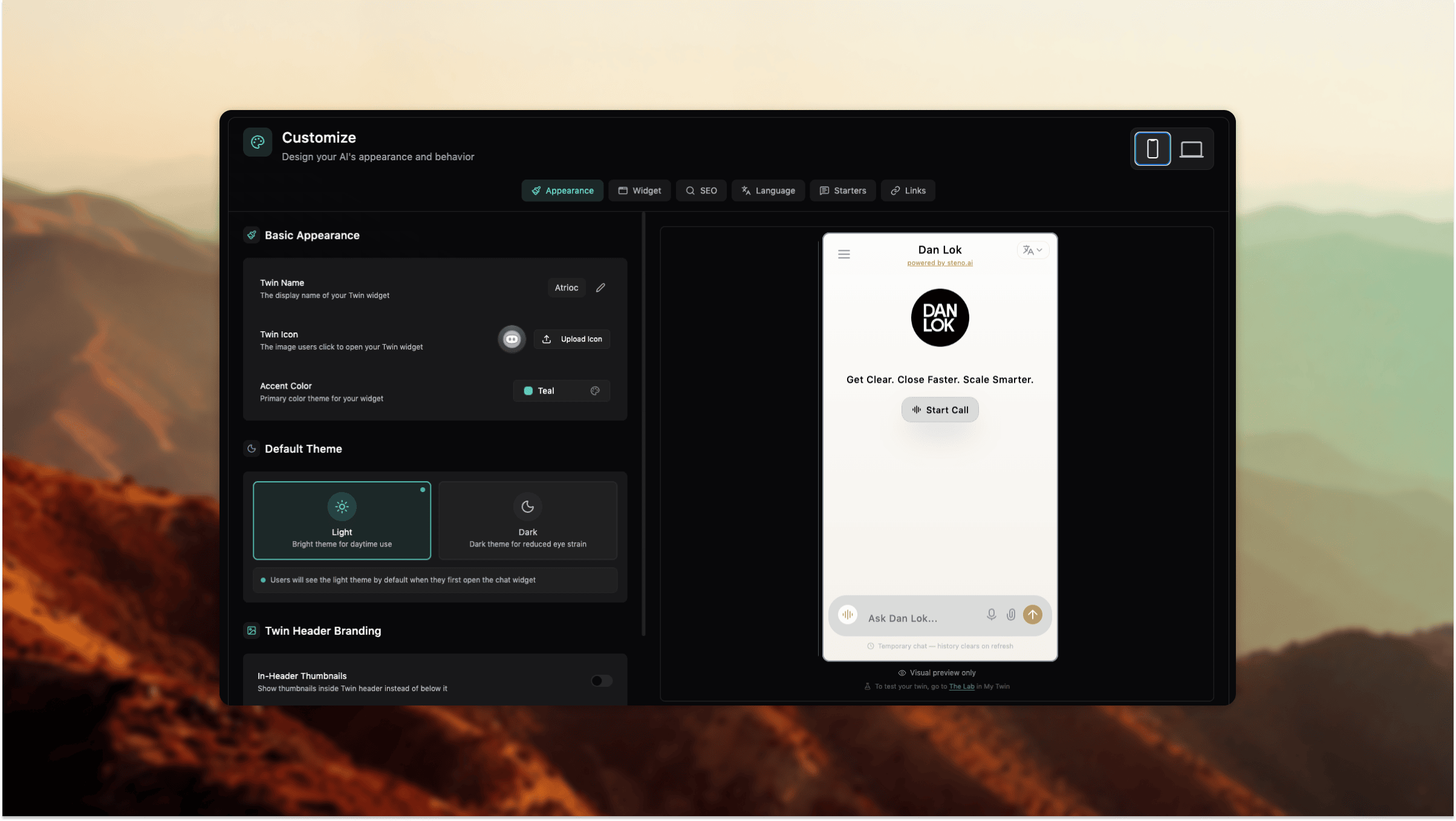
Coaches are deploying AI Twins in three ways, and the right model depends on where you are in your business:
Standalone product. You launch your AI Twin on your own domain and charge a monthly subscription for access. $20–$50/month is the range most coaches are landing on. A coach with 10,000 followers converting 5% at $30/month generates $15,000 in monthly recurring revenue. The Twin runs 24/7 with zero additional time from you. Pure margin.
Companion to existing programs. You bundle your AI Twin with an existing course or coaching program you're already selling. Clients get 24/7 access to your expertise between live sessions or modules — they can ask your Twin questions at 2am when they're stuck on implementation instead of waiting for the next webinar. Retention improves. The offer becomes significantly harder for competitors to replicate.
Lead magnet. You give prospective clients free access to your Twin. They experience your methodology firsthand through a real conversation, not a landing page. When they're ready for the full experience, they've already built trust with your approach. Your Twin effectively sells for you by demonstrating what working with you actually feels like.
Why This Works Where Group Programs Don't
Group coaching and courses scale your time. An AI Twin scales you.
A pre-recorded course delivers the same material to everyone regardless of where they are, what they're struggling with, or what they've already tried. It's efficient but impersonal. A group coaching call gives everyone access to you, but the attention is divided. Twenty people in a room means each person gets a fraction of your presence.
An AI Twin holds a 1:1 conversation with every single person. It remembers what they said last time. It adapts its guidance based on their specific situation. It delivers your frameworks in the sequence that makes sense for that individual, not for the group average. And it does this simultaneously for 10 people, or 100, or 1,000.
The experience on the other end doesn't feel like a course. It feels like having the coach's direct attention. Because in a meaningful sense, it is.
What Makes a Good AI Twin (And What Doesn't)
Not every AI product in this category delivers the same experience. There's a wide gap between a generic AI that's read your blog posts and a true AI Twin that embodies your coaching presence. A few things separate the two:
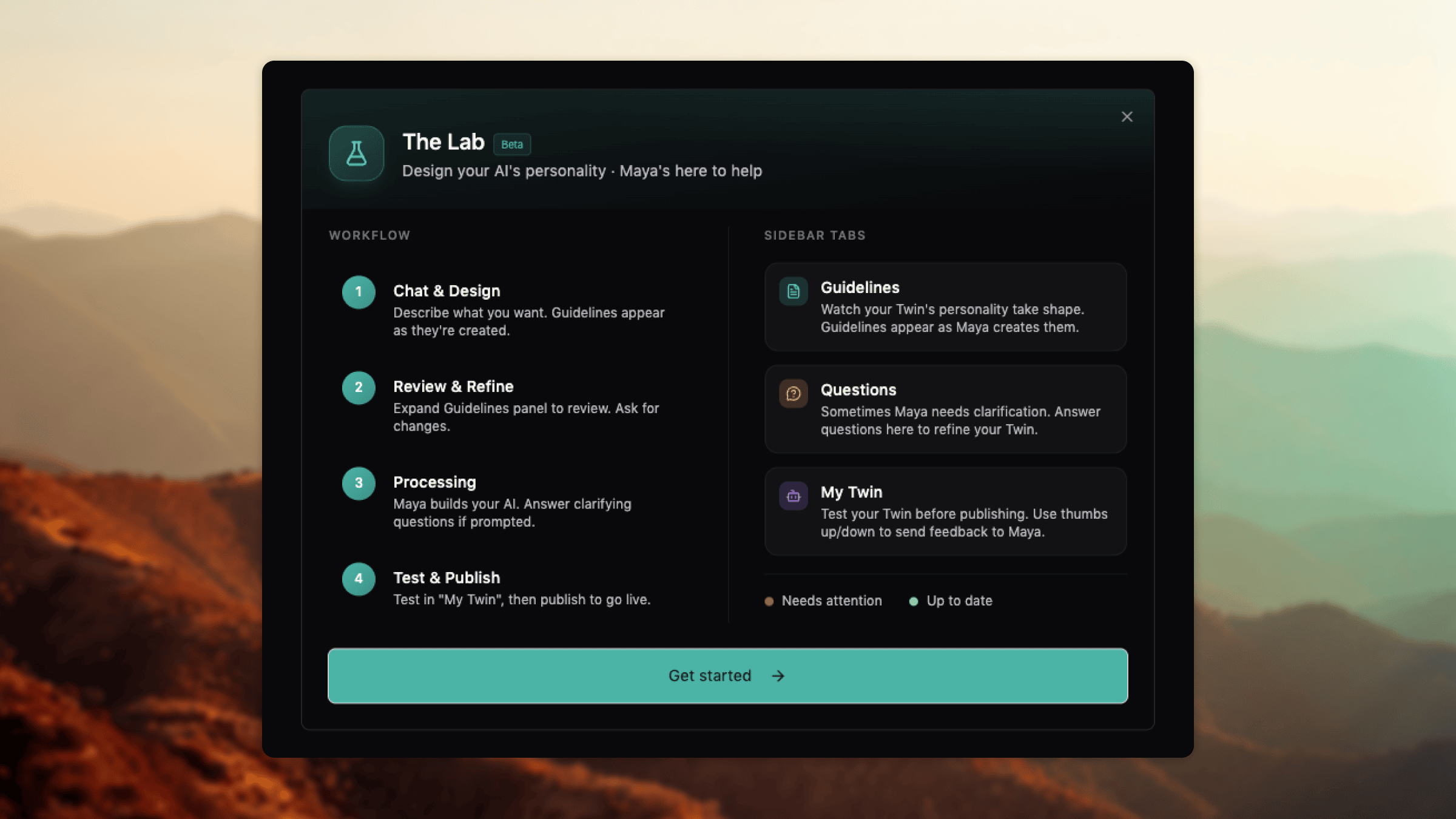
Voice, not just text. Coaching is a conversation. The AI Twins worth considering offer real-time voice cloning — your Twin speaks in your actual voice during live conversations. Steno.ai's Twin Engine technology delivers this with just 2–4 minutes of recorded audio for a standard clone.
Memory across sessions. If someone tells your Twin about a challenge on Monday and comes back Thursday, the Twin should pick up where they left off. Without proactive memory, every conversation starts from zero. That's not coaching, that's customer support.
Guardrails that protect your brand. Your Twin should never make claims you wouldn't make, recommend approaches you wouldn't recommend, or drift into territory that could damage your reputation. Configurable guardrails keep the conversation within boundaries you define.
Deployment on your terms. Your Twin should live on your domain, inside your ecosystem, connected to your existing member areas. Not inside someone else's app where you're building their audience. The best AI Twins offer custom domain deployment, embedded widgets, branded mobile apps, and SDK integration with Kajabi, GoHighLevel, and Mighty Networks.
Monetization built in. If you want to charge for access, the infrastructure should be native — subscription billing, transaction processing, member syncing. Not stitched together with three random workflows and a prayer.
The Shift That's Already Happening
Tony Robbins has an AI Twin. So do Peter Diamandis and Brian Tracy. These aren't experiments. They're live products serving real audiences.
But the bigger story isn't celebrity coaches adopting the technology. It's the coaches with 10,000 followers and a methodology that works, the ones who've been stuck at the one-on-one ceiling for years, discovering they can finally scale the part of their business that matters most. Their personal presence.
The coaching industry is worth an estimated $20 billion globally (per the International Coaching Federation and industry analysts), and the vast majority of that revenue is still trapped in an hours-for-dollars model. AI Twins don't replace the coach. They extend the coach's reach to every person who wants access to their thinking, in every time zone, in every language, at every hour of the day.
The ceiling is real. But for the first time, there's a way through it that doesn't require sacrificing the thing your clients actually pay for.
“This isn't about replacing human connection. It's about multiplying it.” — Tony Robbins
Frequently Asked Questions
How do coaches use AI Twins to scale their one-on-one coaching? Coaches deploy AI Twins in three ways: as a standalone paid subscription ($20–$50/month for 24/7 access), as a companion bundled with existing courses or programs to boost retention, or as a lead magnet that lets prospects experience the coach's methodology through a real conversation. The Twin is trained on the coach's actual content and speaks in their cloned voice.
Can an AI Twin really replicate a coach's personal brand voice? Yes. The best AI Twins use voice cloning technology that replicates a coach's actual voice from audio samples — as little as 2–4 minutes of recorded audio. The Twin speaks with the coach's cadence, tone, and vocal characteristics during real-time conversations. Combined with training on their content library, the result is an AI that delivers the coach's methodology in their own voice.
What's the difference between an AI Twin and a chatbot for coaches? An AI Twin is trained on a specific person's knowledge, methodology, and voice. It holds dynamic, contextual conversations and remembers each user across sessions. A chatbot follows pre-scripted decision trees and gives generic responses regardless of who's asking. It's the difference between a coaching session and an FAQ page.
How much does it cost to build an AI Twin for coaching? Pricing ranges from $99/month for text-only AI coaching clones to $500–$3,000+/month for full-stack AI Twins with voice cloning, monetization infrastructure, and mobile app deployment. Steno.ai's Growth plan at $1,000/month is the most popular among active coaches. The ROI depends on audience size and pricing model — even modest conversion rates at $30–$50/month produce significant recurring revenue.
Is an AI Twin meant to replace one-on-one coaching? No. An AI Twin extends a coach's presence to people who can't get on their calendar. Many coaches use their Twin to handle the initial relationship — answering questions, delivering frameworks, building trust — and reserve live sessions for high-touch work. The Twin handles scale. The coach handles depth.